A buyer working the Kona Coast in 2026 usually runs the same mental spreadsheet at every stop. Purchase price, projected nightly rate, occupancy, work backward to a return. It's a reasonable exercise at Kukio, at Mauna Lani, at Hualalai, where the zoning was built for exactly that math. Run the same spreadsheet at a Hōkūlia homesite and the number that's missing isn't a soft one. It's a legal one.
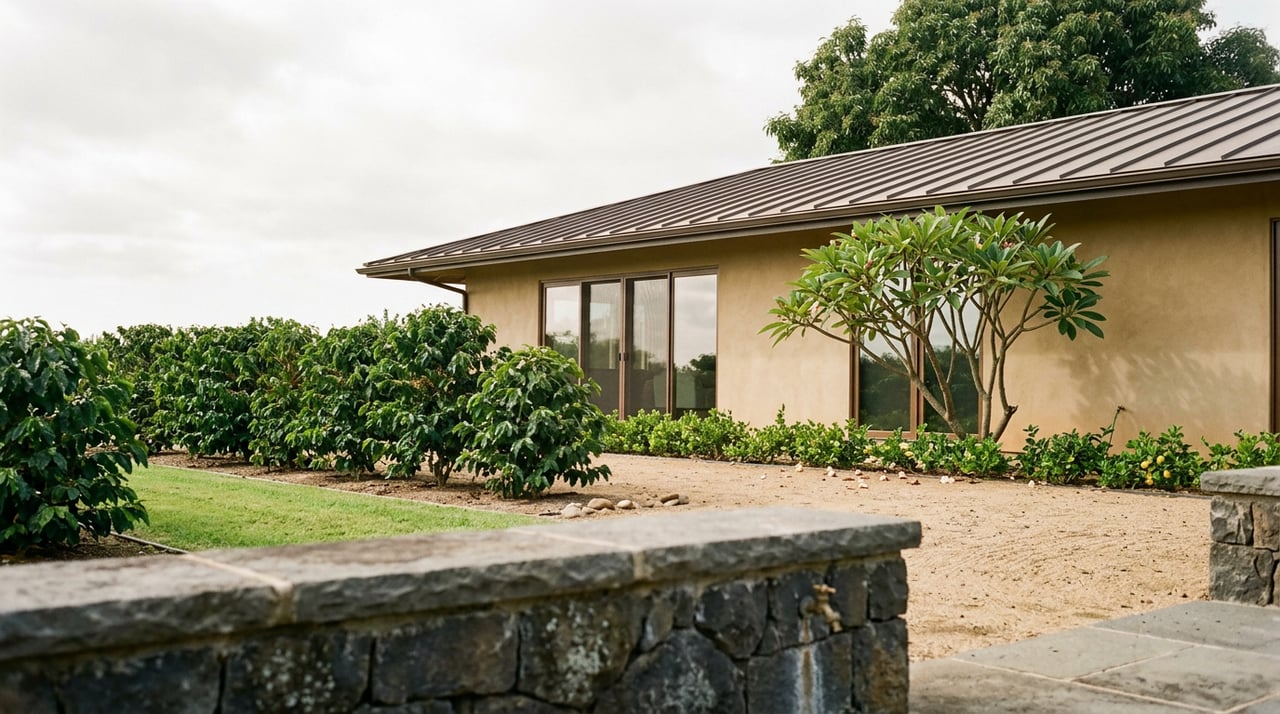
Hōkūlia markets itself as an agrihood, and that word is doing more work than it sounds like it is. The community is zoned for agricultural and residential use, and every homesite carries a recorded agricultural easement, the same easement that lets an owner plant coffee, fruit trees, or a kitchen garden and that ties into a countywide farm-to-table network delivering produce to hundreds of households across the island. That's the version of the zoning the brochures lead with. There's a second version that a comparison shopper needs to see before they get attached to a lot: agricultural and residential zoning is precisely the combination that Hawai'i County's short-term rental law was written to exclude.
What Bill 108 actually drew a line around
Hawai'i County's governing ordinance on this, adopted in 2018 as Ordinance 2018-114 and known locally as Bill 108, defines a short-term vacation rental as a dwelling of five bedrooms or fewer, rented for 30 consecutive days or less, where the owner doesn't live on site. The ordinance then does something buyers moving between resort corridors and private residential communities often miss: it permits that use only in hotel, resort, and certain commercial or multi-family zones, and it bars new short-term vacation rentals in both residential zones and agricultural zones. Not one or the other. Both.
A lot at a resort-zoned community clears that bar by definition. A Hōkūlia homesite, zoned agricultural and residential, sits on the wrong side of it twice over, and Bill 108's one narrow exit ramp doesn't help most owners here. The ordinance allows an existing short-term rental predating the 2019 restrictions, or a farm dwelling built before 1976, to apply for a Nonconforming Use Certificate and keep operating outside a permitted zone. Hōkūlia's homes were built as an owner-occupied private club community from the ground up, not as legacy rental stock from an earlier era of the coast, which leaves little for a certificate to attach to.
The ruling that closed the other door
Buyers sometimes assume the agricultural side of that zoning is the more flexible half, since agricultural land carries a reputation for looser oversight than residential. The Hawai'i Supreme Court closed that assumption in September 2024. Ruling on a case that had worked through the Land Use Commission and the Third Circuit Court, the justices held that a farm dwelling in the agricultural district cannot be used as a short-term vacation rental because that use doesn't accord with the purpose of the agricultural district itself. The same 1976 state law that defines a farm dwelling as one connected to active agriculture and farm income is the law the court leaned on, and it applies to any agricultural parcel on the island, Hōkūlia's homesites included.
So the two backstops aren't redundant. Bill 108 handles the zoning map. The 2024 ruling handles the loophole a clever owner might otherwise have tried to argue through the agricultural side of a dual-zoned lot. Together they mean a Hōkūlia address was never a candidate for the nightly-rate math a resort-zoned neighbor runs.
What that income actually looks like next door
The clearest way to see what's being foreclosed is to look just down the highway, in the parts of Kealakekua and Captain Cook that sit outside Hōkūlia's gates and in zoning that permits it. One rental-analytics platform's 2026 estimate puts the median short-term rental host in Kealakekua at roughly $44,600 a year, with an average daily rate near $195 and about 70 percent occupancy. In Captain Cook, the same kind of estimate lands closer to $40,500 a year at a slightly higher nightly rate and somewhat lower occupancy. Those numbers describe legally operating hosts, generally properties that qualify for a permitted zone or hold a grandfathered certificate. They're a rough picture of the income a similarly situated home could generate if the zoning allowed it. At Hōkūlia, it doesn't, and no amount of registration paperwork changes that.
The 2026 registration wave doesn't reach this question
This is the part that trips people up right now, because 2026 has been a loud year for short-term rental regulation on the Big Island. Ordinance 25-50, known as Bill 47, requires every transient vacation rental owner on the island to register with the county, with the deadline pushed from December 2025 to July 1, 2026, and county council members separately discussing a grace period running from September 1 through the end of the year. Registration runs $250 a year for a hosted rental and $500 for an unhosted one, and operating without registering can draw a fine of up to $10,000. A follow-on measure, Bill 147, has been moving through Leeward and Windward planning commission hearings over the summer, adding operational standards on top of the registration layer.
All of that is real, and it's worth knowing if you're comparing Hōkūlia to any Kona Coast property where a rental income assumption is on the table. But it's a separate question from zoning. Registration and enforcement determine how a legal short-term rental operates. Zoning determines whether one can exist at a given address at all. A Hōkūlia owner doesn't need to track Bill 47's deadlines or Bill 147's operational standards for the simple reason that there's no legal short-term rental use here to register in the first place. The county's tightening enforcement elsewhere on the island doesn't loosen anything at Hōkūlia. If anything, a county actively cross-referencing registrations against listing platforms is a county more likely to notice an agricultural-zoned address trying to operate outside its permitted use, not less.
What the restriction actually buys
It's worth sitting with what this zoning trade-off produces rather than treating it purely as a limitation. A community where every homesite is barred from transient rental turnover is a community where the people on the golf cart paths, at the shoreline park, and in line at the clubhouse are largely owners, not a rotating set of week-long guests. The agricultural easement that closes off the Airbnb math is the same mechanism that keeps small-scale farming, the CSA partnerships, and the working coffee trees part of daily life here rather than a marketing photo. Low density and owner occupancy aren't a byproduct of Hōkūlia's zoning. They're the point of it, and the same rule that rules out nightly rental income is the rule protecting the quiet that a custom-estate buyer or a second-home buyer came here looking for in the first place.
| Hōkūlia | Resort-zoned Kona Coast community | |
|---|---|---|
| Zoning | Agricultural and residential, easement on every homesite | Hotel or resort |
| Short-term rental under Bill 108 | Barred for new use; narrow certificate path for pre-1976 farm dwellings or pre-2019 operating rentals | Permitted as of right |
| Effect of the 2024 Supreme Court ruling | Directly applicable; farm dwellings can't be used as STVRs | Not applicable |
| 2026 Bill 47 registration | Largely moot, since there's no legal STVR use to register | Required, $250 to $500 annual fee |
| Income model to plan around | Owner use, long-term lease of 30 days or more, or a family compound | Nightly rental income, subject to registration and tax filings |
A few questions worth asking before you write an offer
Can I do a long-term lease instead? Bill 108's restriction targets rentals of 30 consecutive days or less. A lease running longer than that sits outside the short-term rental definition entirely, which is the path most owners here who want any rental flexibility actually use.
Does an existing home at Hōkūlia ever qualify for a Nonconforming Use Certificate? It's worth asking your agent to check the specific lot's history, but the certificate path requires either a farm dwelling built before 1976 or a short-term rental operating before the 2019 restrictions took effect. Given that Hōkūlia's development began in the late 1990s as an owner-occupied private club, most homesites here have no such history to point to.
Does the agricultural easement mean I have to farm the lot to close? That's a related but separate question, tied to active-use and tax-classification requirements rather than the short-term rental rules covered here, and worth a direct conversation with your agent before you assume either way.
If you're weighing a Kona Coast property against Hōkūlia and rental income is part of the calculation, that's exactly the kind of question worth working through before an offer, not after closing. Hōkūlia's sales team, led by Nicole Fujitani and Akemi Rubenstein, walks buyers through zoning, easement terms, and what a specific homesite can and can't do, in plain terms and without the pressure. Hōkūlia has homesites, golf-front parcels, and completed estates available now. View properties and start the conversation with a team that knows this zoning from the inside.